China Top 10 LED Filament Bulb Manufacturers?
LED Filament Bulbs combine the warm appearance of vintage carbon filaments with modern LED efficiency. Their clear glass envelopes, amber coatings, and exposed light strips suit restaurants, hotels, homes, and decorative commercial spaces. China remains a major production base for this category, supported by mature LED packaging, glass forming, driver assembly, and export supply chains.
Industry data shows why this market deserves closer examination. The International Energy Agency has reported that LED products now represent a substantial share of global lighting sales, reflecting their lower energy use and longer service life. Grand View Research estimates that the global LED lighting market was worth approximately USD 78.95 billion in 2023, with continued growth expected through 2030. However, market estimates differ by definition, region, and product scope. That limitation matters.
This guide examines China’s top 10 LED Filament Bulbs manufacturers through practical criteria. These include manufacturing experience, product consistency, lumen output, color rendering, flicker performance, thermal design, certifications, customization, and export capability. A beautiful bulb is not automatically a reliable bulb. Its performance may change after continuous operation, especially inside enclosed fixtures.
We also consider evidence from company catalogs, factory information, testing documentation, and buyer feedback. Products with CRI 90 or higher, stable 220–240V performance, and tested lifetimes deserve closer attention. Yet supplier rankings are never permanent. Prices, component sourcing, production capacity, and compliance records can change quickly. This list is therefore a practical starting point, not an absolute verdict.大小规律
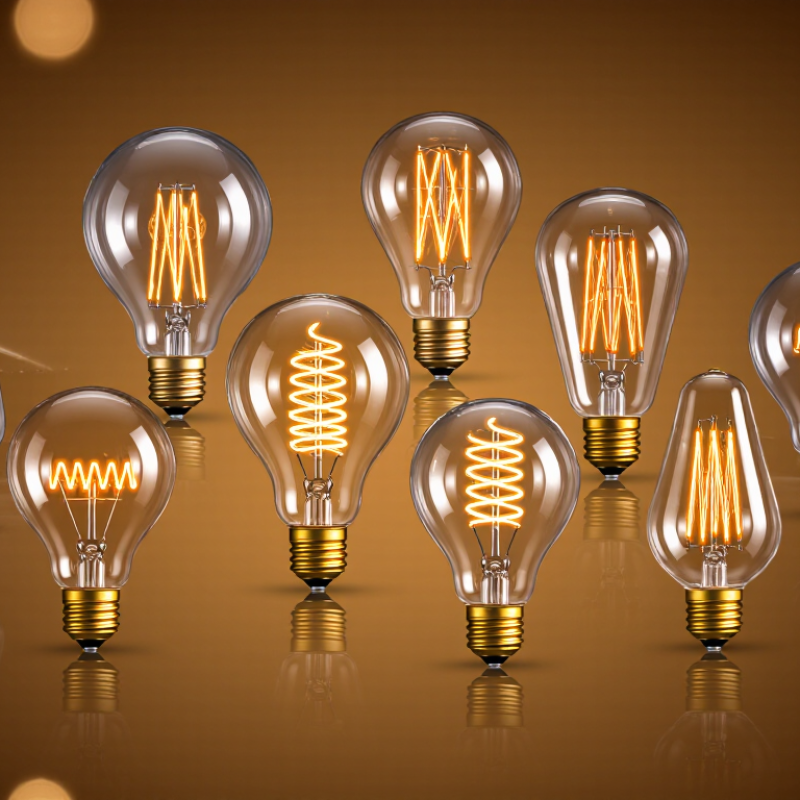
What Are LED Filament Bulbs?
What Are LED Filament Bulbs?
LED filament bulbs are solid-state lamps designed to resemble traditional incandescent bulbs. Inside the clear glass envelope, slim LED strips imitate glowing wire filaments. A phosphor coating converts blue LED light into warmer tones, often around 2,200–3,000 kelvin. The bulb also contains a driver that regulates electrical current.
Their appearance is only part of the story. The U.S. Department of Energy reports that LED products can use at least 75% less energy than incandescent lighting and last up to 25 times longer. The International Energy Agency estimates that lighting represents about 15% of global electricity consumption. These figures explain the market’s interest in efficient decorative lighting.
Still, filament designs involve compromises. Narrow LED strips and compact drivers can limit heat dissipation, brightness, or dimming quality. A glass bulb may look authentic but perform poorly in a closed fixture. I would check lumens, color-rendering index, power factor, rated life, and compatibility with dimmers before comparing manufacturers. Not every vintage-style bulb is truly efficient. This detail is easy to overlook. Product claims also need independent testing, because laboratory ratings may not match dusty rooms, frequent switching, or high ambient temperatures. Industry reports provide useful benchmarks, but real installations remain the harder test.
China’s Top 10 LED Filament Bulb Manufacturers
China’s Top 10 LED Filament Bulb Manufacturers are often judged by more than factory size. Reliable suppliers usually show stable production lines, tested LED chips, and clear quality records. They should explain color temperature, lumen output, beam angle, and lifespan without vague promises. Good manufacturers also provide samples before large orders. This matters because a warm 2700K bulb can look very different from a 3000K bulb in a finished room.
The strongest factories usually support custom shapes, glass finishes, dimming options, and various base types. Their production teams should manage aging tests, electrical checks, and visual inspections. Export experience is useful, but it does not guarantee consistent quality. Some suppliers present impressive catalogs while offering weak sample control. I have found that simple questions often reveal more than polished brochures. Ask how rejected bulbs are recorded and how production changes are approved.
Tips: Request three samples from separate batches. Check brightness after several hours. Compare color stability, flicker, heat, and dimmer performance. Confirm packaging strength with a small trial shipment. A low unit price may hide higher replacement costs. Also, ask for recent test reports from independent laboratories. Reports should match the exact bulb model, not a similar product. My ranking approach may still miss smaller factories with excellent workmanship, so onsite audits remain valuable.
China’s Top 10 LED Filament Bulb Manufacturers: Industry Specification Benchmark
This chart presents representative retail specifications commonly used for LED filament bulbs, including nominal power and brightness. The values reflect standard market ratings rather than company-specific or brand-specific data, so they are intended for product comparison instead of manufacturer ranking.
Comparing Product Range, Quality, Certifications, and Pricing
Comparing China’s top ten LED filament bulb manufacturers requires more than checking catalog size. Strong suppliers usually offer E27, E14, B22, and decorative globe bases. Their ranges may include 2W to 8W bulbs, amber or clear glass, and color temperatures from 2200K to 6500K. Dimmable options, high CRI models, and low-flicker drivers also matter for hospitality and residential projects. Product variety is useful, but a large catalog can hide inconsistent engineering.
Quality should be verified through samples, not promises. Inspect solder joints, glass alignment, driver insulation, and heat behavior after several hours. Ask for LM-80 data where relevant, photometric reports, and flicker test results. Certifications such as CE, RoHS, EMC, and LVD can support market access, but certificates should match the exact model and factory. ISO 9001 shows process control, though it cannot guarantee every batch. Small details matter.
Pricing often changes with wattage, glass shape, LED filament design, packaging, and order volume. Basic bulbs may appear inexpensive, while dimmable, high-CRI products cost more. Request a complete quotation, including testing, packaging, tooling, and delivery terms. A low price is not automatically a bargain. I would compare three sample batches before choosing a supplier. Even then, some specifications may need revision after installation tests. A beautiful 4W bulb can still disappoint if its claimed brightness, color stability, or dimming performance is not independently checked.
China Top 10 LED Filament Bulb Manufacturers? - Comparing Product Range, Quality, Certifications, and Pricing
Note: The supplier profiles are anonymized. Product specifications, certification availability, minimum order quantities, and FOB prices are indicative market ranges for China-made LED filament bulbs and should be verified against current model-specific quotations, test reports, and export requirements.