
How Long Can a Fridge Last Without Power in 2026?
how long can a fridge last without power is not a simple appliance question. It is a food-safety decision measured in hours, temperature, and uncertainty. The U.S. Department of Agriculture’s Food Safety and Inspection Service (USDA FSIS) states that an unopened refrigerator generally keeps food safe for about four hours. The U.S. Food and Drug Administration (FDA) uses the same critical benchmark: perishable foods should be discarded after reaching unsafe temperatures for too long.
Keep the door closed. That matters most. A refrigerator should remain at 40°F (4°C) or below, according to FDA guidance. After four hours, meat, seafood, milk, eggs, and leftovers require careful evaluation. Smell is not reliable. Neither is appearance. That is where many households make a risky mistake.
Freezers provide more time. USDA FSIS reports that a full freezer can hold a safe temperature for approximately 48 hours, while a half-full freezer may last about 24 hours. A small thermometer inside can reveal more than guesswork. An unopened door, packed shelves, and a cool room may extend the margin slightly, but they do not cancel the rule. Power outages are becoming harder to predict, and a 2026 emergency plan should include appliance thermometers, sealed ice packs, and a cooler. Four hours passes quickly. This guidance is practical, but not perfect; exact conditions vary, so when temperature history is unknown, throwing food away is the safer decision.
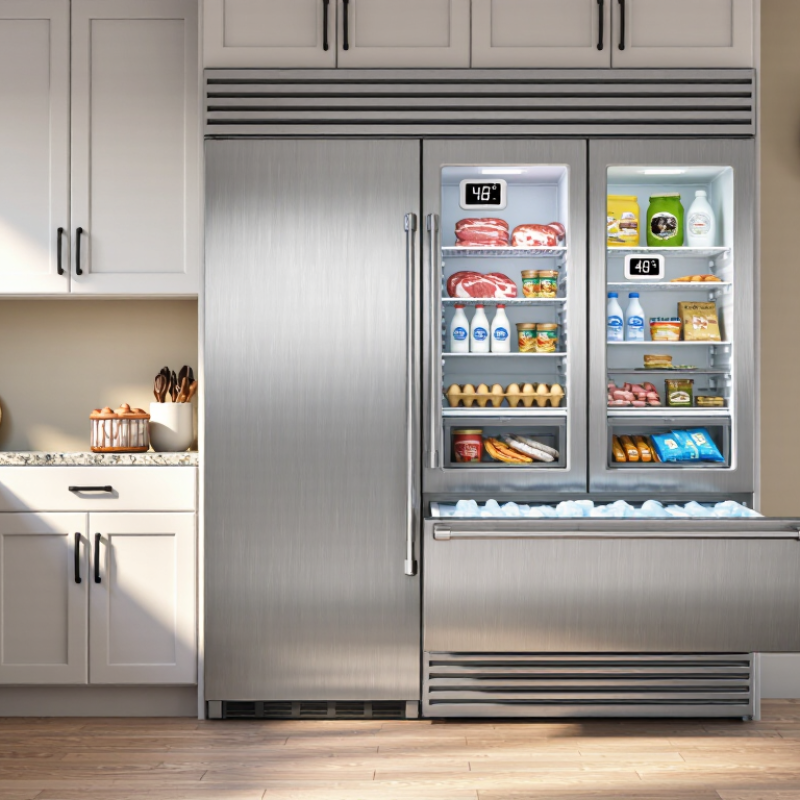
How Long a Fridge Can Stay Cold Without Electricity
How Long Can a Fridge Last Without Power in 2026?
A closed refrigerator usually stays safely cold for about four hours without electricity. That estimate assumes a normal room temperature and a full door seal. Opening the door changes everything. Warm air enters quickly, while chilled air spills out. A packed freezer can hold its temperature for about 48 hours. A half-full freezer may last only 24 hours. These figures are practical guidelines, not promises. A small thermometer gives better evidence than touch. Food can feel cool while its temperature rises into an unsafe range.
Tips: Keep both doors closed during an outage. Move highly perishable food into an insulated cooler with plenty of ice. Keep the cooler in the shade, and avoid repeated checking. If refrigerated food stays above 4°C (40°F) for more than two hours, discard it. The limit becomes one hour when the room exceeds 32°C (90°F). Never taste food to test its safety. That habit can mislead you. When power returns, check the appliance thermometer, not just the lights. Some fridges restart slowly, especially after a long interruption.
Modern insulation can improve cold retention, but age, door seals, room heat, and food quantity still matter. A fridge beside a sunny window may warm sooner. I would rather waste questionable food than trust a hopeful guess. That choice feels frustrating. It is also the safer one.
Factors That Affect Food Safety During a Power Outage
How Long Can a Fridge Last Without Power in 2026?
Food safety depends on more than the clock. An unopened refrigerator usually keeps food cold for about four hours during an outage. A full freezer may hold its temperature for 48 hours, while a half-full freezer may last about 24 hours. These are practical estimates, not guarantees.
Room temperature matters greatly. A refrigerator in a hot kitchen warms faster than one in a cool basement. Frequent door opening releases cold air. A tightly packed freezer usually stays cold longer. Raw meat, seafood, milk, and leftovers are especially risky when temperatures rise above 4°C (40°F). Food safety authorities generally recommend discarding perishables kept above that temperature for over two hours. That limit may drop to one hour in extreme heat. Smell is not a reliable safety test. I have found that relying on appearance feels sensible, but it can create false confidence.
Tips: Keep the doors closed, and place a refrigerator thermometer inside. Move food to a cooler with plenty of ice when possible. Store meat below ready-to-eat foods to prevent leaking. If frozen food still contains ice crystals, it may be safely refrozen, although its texture can suffer. When uncertain, throw it away. It feels wasteful, but stomach illness costs more. Record the outage time, because memory becomes surprisingly unreliable during stressful events.
How Long Can a Fridge Last Without Power in 2026? - Factors That Affect Food Safety During a Power Outage
| Food-storage situation | Typical time without power | Temperature or condition | Recommended food-safety action |
|---|---|---|---|
| Closed refrigerator | About 4 hours | Door remains closed; internal temperature should stay at or below 40°F (4°C) | Keep the door shut. After approximately 4 hours without power, move perishable foods to ice or discard them if their safety cannot be confirmed. |
| Full freezer | Up to 48 hours | Door remains closed; food stays frozen or contains ice crystals | Keep closed. Food may generally be refrozen or cooked if it still contains ice crystals or has remained at 40°F (4°C) or below. |
| Half-full freezer | About 24 hours | Less frozen food provides less thermal insulation | Check for ice crystals or measure the temperature. Discard food that has been above 40°F (4°C) for more than 2 hours. |
| Perishable food above 40°F (4°C) | Maximum 2 hours | Food is in the danger zone between 40°F and 140°F (4°C and 60°C) | Discard meat, poultry, seafood, eggs, dairy, cooked leftovers, and cut produce held above 40°F for over 2 hours. |
| Perishable food in very hot conditions | Maximum 1 hour | Surrounding temperature is above 90°F (32°C) | Discard temperature-sensitive food held above 40°F (4°C) for more than 1 hour. |
| Unopened shelf-stable foods | Usually safe during the outage | Commercially canned, dried, or unopened shelf-stable products | Store in a cool, dry place. Inspect cans and packages for damage, swelling, leakage, or broken seals. |
| Foods that naturally keep longer | Often several days, depending on the food | Whole fruits, vegetables, bread, hard cheeses, and unopened shelf-stable products | Check quality and packaging. Refrigeration may affect quality, but not every food is equally hazardous when warm. |
| Food with ice crystals | May be refrozen | Food remains partially frozen or measures 40°F (4°C) or below | Refreezing is generally acceptable, although texture and quality may decline. |
| Temperature cannot be verified | Use elapsed time as the guide | No appliance thermometer or reliable temperature record | When in doubt, discard high-risk perishable foods rather than relying on smell, appearance, or taste. |
How to Check Whether Refrigerated Food Is Still Safe
How Long Can a Fridge Last Without Power in 2026?
A closed refrigerator usually keeps food cold for about four hours without power. Open the door only when necessary. Warm air enters quickly, especially in a busy kitchen. Use a refrigerator thermometer if available. Food should remain at 40°F (4°C) or below. If the temperature rises, bacteria can multiply without changing the food’s smell or appearance.
Check high-risk foods carefully. Discard meat, poultry, seafood, eggs, milk, soft cheese, and cooked leftovers if they stayed above 40°F for over two hours. That limit drops to one hour when the room exceeds 90°F. Never taste questionable food. A sour smell is a warning, not a safety test. I once relied too heavily on appearance, and that was not a reliable choice. A clean surface does not prove safe storage.
Keep the door shut, and record the outage time. Move food to a cooler with plenty of ice if power may be delayed. Keep raw meat sealed below ready-to-eat food. Frozen items may still be safe if they contain ice crystals or feel refrigerator-cold. Refreeze them only after checking their condition. When timing is unclear, throwing food away is the safer decision, even when it feels wasteful.
Safe Steps for Managing a Fridge During Extended Outages
How Long Can a Fridge Last Without Power in 2026?
Safe Steps for Managing a Fridge During Extended Outages
An unopened refrigerator usually keeps food cold for about four hours. After that, temperatures can enter the danger zone above 40°F (4°C). A full freezer may stay safe for nearly 48 hours. A half-full freezer generally lasts about 24 hours. These times depend on room temperature, food volume, and door openings. Keep the doors shut. Every opening releases valuable cold air.
Place a refrigerator thermometer inside before an outage happens. During the outage, avoid tasting food to judge safety. Perishable food held above 40°F for two hours should be discarded. If the room exceeds 90°F, use one hour instead. Move food into an insulated cooler with plenty of ice. Keep raw meat sealed below ready-to-eat foods. Leaking packages can contaminate everything nearby. I sometimes want to save expensive food, but uncertainty is not a reliable safety test.
Tips: Freeze water containers ahead of time. Leave space around chilled items for airflow. Write the outage time on a piece of paper. Check ice crystals before refreezing food. Food that still contains ice crystals may be refrozen, though texture can suffer. Clean spills with warm, soapy water after power returns. Do not reconnect a damaged appliance. When unsure, discard it.
How Long Can a Fridge Last Without Power in 2026?
Keep the refrigerator door closed during an outage. An unopened refrigerator generally keeps perishable food safe for up to 4 hours. A full freezer can remain cold for about 48 hours, while a half-full freezer may last about 24 hours.
If the power has been off for more than 4 hours, discard perishable food that has been above 40°F (4°C). Do not taste food to check whether it is safe. Use a food thermometer when power returns, and move food to a cooler with ice if the outage is expected to continue.
When to Discard Food After the Power Returns
When power returns, do not assume the refrigerator is safe. A closed fridge usually keeps food cold for about four hours. After that, temperatures can enter the danger zone, between 4°C and 60°C. Bacteria may multiply even when food looks and smells normal.
Check the time, temperature, and food type. Discard meat, poultry, seafood, eggs, milk, soft cheese, cooked rice, and leftovers if they stayed above 4°C for over two hours. If the room was hotter than 32°C, use one hour instead. Never taste food to test its safety. That small bite can carry a serious risk.
A freezer is different. Food remains frozen for roughly 48 hours when full, or 24 hours when half full, if the door stays closed. Ice crystals usually mean it can be refrozen or cooked immediately. Still, quality may suffer. I once trusted a partly thawed package because it felt cold, and that judgment was too casual. A refrigerator thermometer gives better evidence than touch. When uncertain, throw the food away. Clean leaking shelves with hot, soapy water, then wash your hands before handling replacement food.
