What Is an IR Corrected Lens Used For?
An IR Corrected Lens is designed to keep visible and infrared light focused on nearly the same image plane. Without this correction, a camera can appear sharp in daylight yet soften when infrared illumination is added. Fine edges may develop a faint halo. Focus can shift, too.
Optical designer Rudolf Kingslake’s published work on lens design offers a useful principle, paraphrased here: a lens must be evaluated across the wavelengths it is intended to handle. This is not a direct quotation. The distinction matters because infrared correction does not make every lens suitable for every camera or wavelength. Check the lens specifications, sensor response, and lighting conditions together.
In practical use, an IR Corrected Lens can help surveillance cameras, machine-vision systems, and other imaging equipment that operates with visible and near-infrared light. Picture a camera inspecting a printed label under changing illumination: stable focus helps preserve readable edges and consistent measurements. Still, correction cannot compensate for poor alignment, a dirty protective window, or an unsuitable working distance. Results vary.
This guide explains what infrared correction changes, where it helps, and what to check before choosing a lens. It also considers a limitation that is easy to overlook: sharper focus does not automatically mean better image quality. A small detail, but an important one.
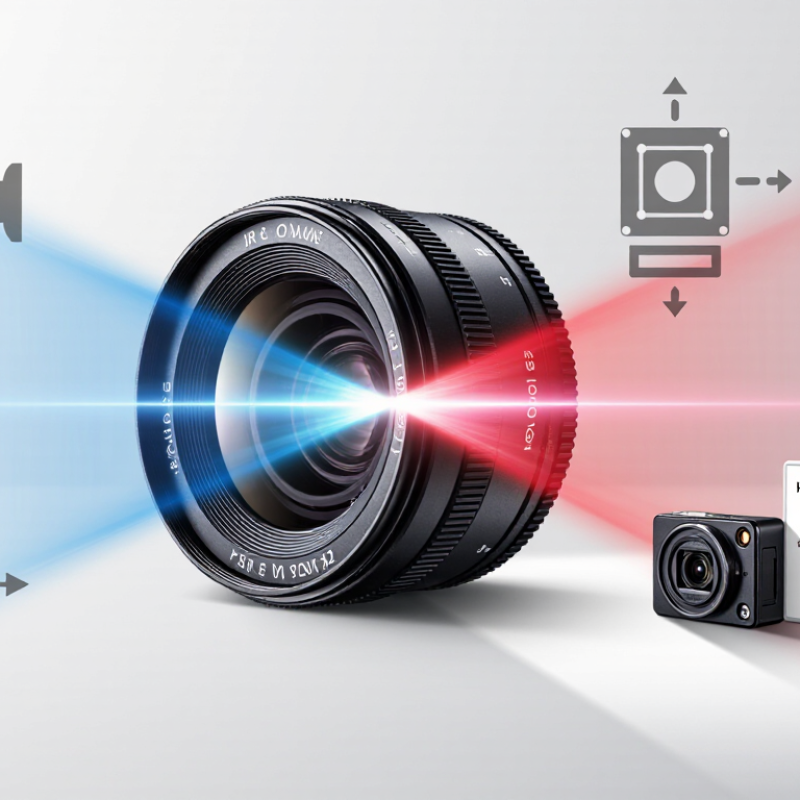
Define IR-Corrected Lenses Across the Typical 400–1,000 nm Imaging Band
An IR-corrected lens is designed to keep visible and near-infrared wavelengths focused at nearly the same image plane. The typical 400–1,000 nm band runs from visible light into near-infrared. Without correction, longer wavelengths can focus differently, softening edges even when the image looks sharp under ordinary lighting. Fine details suffer. This matters in outdoor monitoring, machine vision, and inspection under mixed lighting, where visible and near-infrared illumination may reach the sensor together.
The range is practical, not universal: sensor response, filters, aperture, and working distance all affect the final image. The EMVA 1288 Release 4.0 standard describes methods for measuring camera spectral sensitivity and quantum efficiency across wavelengths. NIST detector-calibration resources likewise report responsivity as a wavelength-dependent measurement, not a single sensitivity value. These references help explain why lens and sensor specifications should be checked together. An IR-corrected lens reduces focus shift; it does not guarantee equal sharpness or brightness at every wavelength. In practice, correction is a compromise, and the edges of the band may still need testing on the actual setup.
What Is an IR Corrected Lens Used For? — Define IR-Corrected Lenses Across the Typical 400–1,000 nm Imaging Band
| Dimension | What It Means | Practical Use or Consideration |
| Typical correction band | Designed to maintain useful focus across a specified visible-to-near-infrared range, such as approximately 400–1,000 nm. | Suitable when one camera system captures visible and near-infrared images without refocusing between bands. The exact supported range depends on the lens design. |
| Reduced focus shift | Different wavelengths can focus at different distances because optical materials refract colors differently. IR correction reduces this chromatic focus change across the stated band. | Helps keep visible and near-infrared details in focus at the same image plane, especially when switching illumination or filters. |
| Multispectral imaging | Captures images in multiple spectral bands, often using filters or separate illumination sources. | Useful for inspection, sorting, and research setups that compare visible and near-infrared responses in the same scene. |
| Machine vision and inspection | Provides imaging across visible and near-infrared wavelengths for cameras used in automated measurement or inspection. | Can support tasks such as checking materials or features whose contrast changes with wavelength; the lens does not itself identify or classify the material. |
| Silicon image sensors | Many silicon sensors respond to visible light and into the near-infrared, with sensitivity declining near their long-wavelength cutoff. | An IR-corrected lens can help use more of a sensor’s visible-to-near-infrared response. Actual performance also depends on the sensor, filter stack, and illumination. |
| Near-infrared is not thermal infrared | The 400–1,000 nm band is visible light plus near-infrared; it is far shorter in wavelength than thermal infrared imaging bands. | These lenses are not thermal-camera lenses and should not be assumed to transmit or focus long-wave infrared radiation. |
| Lens specification to verify | Check the stated wavelength range, image format, focal length, aperture, working distance, and any filter or cover-glass requirements. | “IR corrected” alone does not guarantee the same sharpness, transmission, or performance across the entire 400–1,000 nm range. |
Summary: An IR-corrected lens is used when visible and near-infrared wavelengths need to form a well-focused image on the same imaging system. Confirm the lens’s specified spectral range and test it with the actual camera, filters, and illumination.
Explain Focus Shift from Visible 550 nm to Near-IR 850 nm
An IR corrected lens is designed to keep focus more consistent across visible and near-infrared light. This matters when a camera uses visible light near 550 nm for setup but captures an image under 850 nm illumination. Ordinary glass bends these wavelengths differently. The result can be a focus shift: a target that looks sharp in visible light may appear soft in near-IR. Small details reveal it. A printed edge, for example, may lose contrast after the illumination changes.
An IR corrected design reduces this shift, but it does not guarantee identical focus at every distance or aperture. Lens construction, sensor filters, and working distance all affect the final image. Check focus under the actual 850 nm lighting whenever possible. If you focus at 550 nm and then switch wavelengths, even a slight change can matter in close-up inspection. It is not magic. Some residual softness may remain, and the correction varies by lens design.
A practical test is to photograph the same fine-textured target at both wavelengths, then compare edge sharpness at the intended working distance. That extra check can prevent a frustrating surprise.
Describe Day/Night Surveillance with 850 nm and 940 nm IR Illumination
What Is an IR Corrected Lens Used For?
Day/Night Surveillance with 850 nm and 940 nm IR Illumination
An IR corrected lens helps maintain focus as a camera switches between daylight and infrared illumination. Ordinary lenses may focus visible and infrared light at slightly different distances. At night, this can soften details even when the camera’s autofocus seems settled. An IR corrected design reduces that shift, keeping edges clearer across day and night. It is useful for outdoor cameras, entrances, and other scenes that need consistent detail after dark.
At 850 nm, infrared LEDs usually provide stronger illumination and support longer usable range. Some LEDs show a faint red glow, which may be noticeable nearby.
At 940 nm, the glow is much less visible, but the camera often receives less light. Images can look darker, especially at distance or in poor weather. The best wavelength depends on the sensor, lens, and scene—not wavelength alone. Results vary.
Tips: Match the lens to the camera’s sensor and IR wavelength. Test focus in daylight, then check a real night scene. Look closely at a face or sign at the frame edges, not only the center. A corrected lens helps, but it cannot compensate for weak illumination or a poorly aimed camera.
Compare Lens Performance by MTF, Spectral Transmission, and Focus Shift
An IR-corrected lens is designed to keep images acceptably sharp across visible and near-infrared wavelengths. That matters when a camera switches from daylight to infrared illumination, or when a sensor must capture both. The correction does not guarantee perfect focus in every setup. Sensor cover glass, filters, aperture, and working distance can all affect the result.
Compare MTF at the wavelengths and image areas you actually use. MTF describes how well a lens preserves contrast in fine detail, such as lettering on a distant label or edges near the frame corners. A chart at one wavelength may look strong while performance softens at another. Check both center and edge measurements. Small details matter.
Spectral transmission shows how much light passes through the lens at each wavelength. A lens may transmit visible light well but lose more energy near the edge of your infrared band. Then examine focus shift: the change in best-focus position between wavelengths. A smaller shift can reduce refocusing when illumination changes, but test with your actual filter and camera. Results can be messier than a specification sheet suggests. Measure at the working distance, aperture, and temperature you expect; a quick bench test may reveal a mismatch.
Match IR-Corrected Lenses to Sensors Covering Visible and Near-IR Light
An IR-corrected lens is designed to keep visible and near-infrared wavelengths focused at nearly the same image plane. That matters when a camera sensor records both bands instead of switching between separate visible-light and infrared setups. Many silicon sensors respond beyond visible red, but internal filters may reduce near-infrared transmission. Check the sensor’s spectral response and any cover glass or IR-cut filter before choosing a lens. Small details matter. An IR-corrected lens cannot make a blocked wavelength reach the sensor.
Match the lens’s stated correction range to the wavelengths your application uses, such as visible light through 850 nm near-infrared. Also confirm image-circle coverage, mount compatibility, working distance, and focus at the intended aperture. At close focus or wide apertures, residual focus shifts and edge softness can still appear. Test a printed chart under visible and near-infrared illumination, keeping the camera position and focus fixed. Inspect fine lines at the center and corners. The result may be imperfect; that is useful evidence, not a reason to trust a label alone. A sensor stack or filter can change the outcome.
What Is an IR-Corrected Lens Used For?
This chart shows the visible and near-infrared wavelength bands relevant to imaging with silicon sensors. An IR-corrected lens is designed to keep focus more consistent across its specified visible and near-IR range.
Wavelength limits are approximate: visible light is commonly defined as 400–700 nm, near-infrared begins around 700 nm, and silicon sensor sensitivity typically falls off near 1,000–1,100 nm. Check the lens and sensor specifications for their actual usable ranges.