Why Is the Bubble Pendant Lamp So Popular?
The Bubble Pendant Lamp has become a familiar sight in kitchens, dining rooms, and living spaces. Its appeal begins with a simple contrast: delicate glass globes can feel light, while their rounded shapes still draw the eye. When switched on, the shades soften the bulb’s brightness and spread a gentle glow across a table or nearby wall. The effect depends on the glass, bulb, and room, though. It is not magic.
Design history helps explain the lamp’s staying power. Mid-century lighting explored sculptural forms and new materials, and bubble-style fixtures still carry some of that playful, modern character. Today, you can find versions with one globe or several, clear glass or opal finishes, and varied metal details. That range makes the design easier to adapt to different interiors. A single pendant can anchor a small breakfast nook; a wider cluster may suit a longer dining table. Measure carefully. Scale matters.
Popularity also comes with practical questions. Clear glass shows dust and the bulb, while a low-hanging fixture may interrupt sightlines or create glare. Before choosing one, consider ceiling height, table size, cleaning access, and the light output you need. Photos can make every pendant look effortless. Real rooms are less forgiving. The Bubble Pendant Lamp earns attention through its recognizable shape and useful versatility, but it is not right for every space. Its success depends on thoughtful placement, not trend alone.
What Is a Bubble Pendant Lamp?
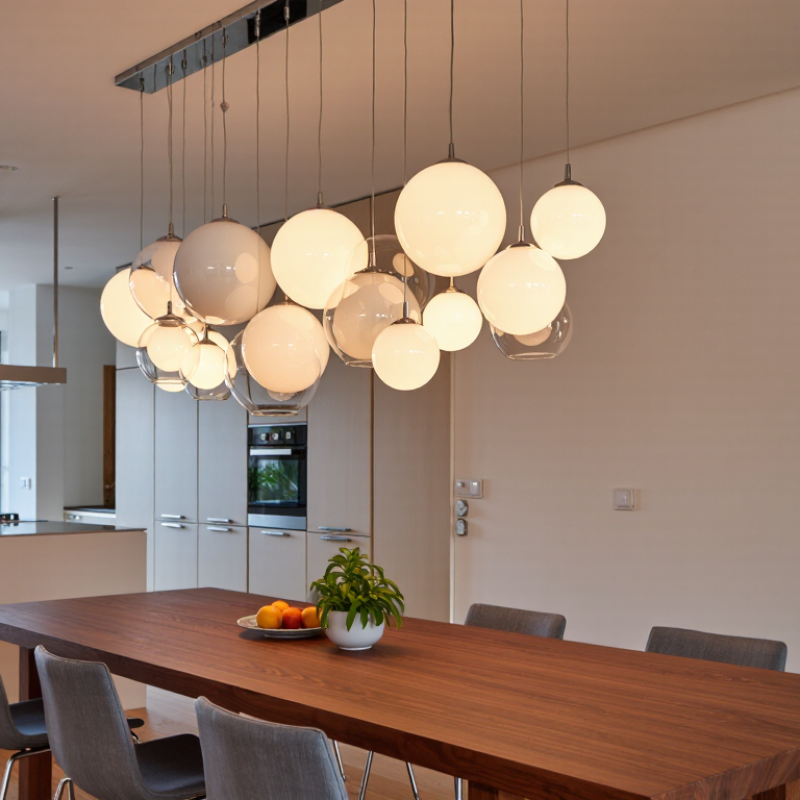
A bubble pendant lamp is a ceiling-hung fixture built around one or more rounded shades. The “bubbles” may be clear, frosted, or softly tinted glass, arranged singly or in a cluster. Their curved surfaces catch window light by day and soften a bulb’s glow at night. Some designs use several globes at different heights, like floating beads above a dining table. Others keep one globe low over a reading chair. The shape sounds simple, but scale matters: an oversized shade can crowd a narrow room, while a tiny one may disappear above a long table.
The fixture is popular partly because it offers a sculptural focal point without needing a busy pattern. Yet clear glass can reveal the bulb and create glare. Frosted glass feels gentler, though it may look less crisp. Small trade-off. The U.S. Department of Energy’s 2020 Lighting Market Characterization found that LEDs made up about 48% of installed U.S. lighting stock. That figure does not measure pendant-lamp sales, but it shows how common efficient light sources have become. ENERGY STAR’s LED guidance says certified LED bulbs use at least 75% less energy and last up to 25 times longer than incandescent bulbs. For a bubble pendant, bulb shape and dimmer compatibility still deserve a check; a beautiful globe can be annoying when it shines straight into your eyes.
Why Is the Bubble Pendant Lamp So Popular? What Is a Bubble Pendant Lamp?
A bubble pendant lamp is a hanging light with one or more globe-shaped shades, often made of glass. Its simple rounded form works across many interiors, while the glass helps spread light through the room. Choosing a color temperature can further shape the atmosphere: warm white feels cozy, while cooler light feels more crisp.
Chart data: representative nominal LED color-temperature options; actual product specifications vary. This is not a popularity survey.
Origins and Key Design Features
Why Is the Bubble Pendant Lamp So Popular?
Origins and Key Design Features
The bubble pendant emerged in 1947, when designer George Nelson sought an affordable alternative to costly Swedish hanging lamps. Their delicate silk coverings were difficult to obtain. He developed a light steel frame coated with translucent plastic instead. The result looked softly inflated, like a pale sphere suspended from the ceiling. Its shape feels simple, but the construction gives it a distinctive presence.
That balance still suits modern rooms. A rounded shade spreads light across a dining table, while its thin frame keeps the fixture from feeling visually heavy. The U.S. Department of Energy’s 2020 U.S. Lighting Market Characterization estimated LEDs represented roughly 47% of installed general-lighting stock. That shift makes low-heat LED bulbs a practical fit for enclosed or diffusing shades, though bulb compatibility still matters. Check the fixture’s specifications. Not every bulb gives the same warmth. The shade’s soft glow can also reduce contrast, so it may not provide enough focused light for detailed tasks. And in a small room, the pendant can feel oversized. That tension is part of its appeal—and its limitation.
Why Is the Bubble Pendant Lamp So Popular? — Origins and Key Design Features | Dimension | Factual Detail | Why It Matters |
| Origins | The best-known Bubble pendant designs were developed by American designer George Nelson in 1947. Accounts of their origin connect the idea to translucent, silk-covered Swedish lamps that were expensive and difficult to obtain. | The design brought an elegant, softly glowing look into a form intended for wider use. |
| Construction | The classic construction combines a lightweight wire framework with a translucent plastic coating. The coating forms a continuous shade around the frame rather than relying on a heavy, solid shell. | The structure helps create a large visual presence without making the pendant appear bulky. |
| Light quality | The pale, translucent shade diffuses light, softening the brightness of the bulb and reducing the direct, bare-bulb effect. | Softened illumination can make the lamp suitable for ambient lighting in living and dining areas. |
| Shape and silhouette | The design family includes rounded, oval, and elongated forms. Their simple geometric outlines are balanced by the fine, web-like appearance of the frame and coating. | Different proportions make the style adaptable to varied ceiling heights, room sizes, and furniture layouts. |
| Visual balance | The shade looks substantial when viewed from a distance but remains visually airy because its surface is light in color and its supporting frame is slender. | This balance lets the pendant act as a focal point without dominating a room as heavily as a dense, opaque fixture might. |
| Interior versatility | Its restrained color palette and clean geometry work with many interior styles, including mid-century-inspired, contemporary, and minimalist spaces. | A recognizable shape paired with a neutral finish is easy to coordinate with changing décor. |
| Enduring appeal | The design has remained recognizable across decades because its defining features—diffused light, a lightweight frame, and a clear geometric silhouette—are not tied to a short-lived decorative trend. | Its mix of function and sculptural form helps explain its continued popularity in residential interiors. |
Materials and How the Lamp Is Made
A bubble pendant lamp gets much of its character from its glass. Clear glass lets light spread widely, while frosted or tinted glass softens the glow. Some shades are mouth-blown; others are formed with molds. The method depends on the design, so the bubbles may look nearly identical or show slight differences. Small variations matter.
In hand-blown production, a glassworker gathers molten glass on a blowpipe and shapes it with controlled air and tools. The piece must cool gradually in an annealing oven, reducing stress that could cause cracks. This process takes skill, but it does not guarantee perfect symmetry. A tiny waviness can be part of the finish, not a flaw. Still, inspect the shade for sharp edges, visible cracks, or uneven coating.
The supporting parts are usually metal, such as steel or brass, with a socket, electrical cord, and ceiling canopy. These components carry the shade’s weight and connect it to the light source. Check that the suspension is rated for the lamp’s actual weight, especially when the glass is thick. It is easy to focus on the glossy sphere and overlook the fitting above it. That detail deserves attention. A well-made lamp should have secure connections and clear care instructions, since glass can show fingerprints and dust quickly.
Common Uses and Interior Design Applications
Bubble pendant lamps work well where a room needs a visible focal point and useful light. A single opal-glass globe can soften a bedside corner, while a row of smaller pendants suits a kitchen island or dining table. Hang the lowest point high enough to preserve sightlines; over an island, check seated and standing views. Clear glass looks crisp, but exposed bulbs can cause glare. Not every room needs a cluster.
Their best use is often layered lighting, rather than serving as the only source. Pair a pendant with recessed or wall lighting, then use a dimmer for meals, reading, or quiet evenings. The International Energy Agency’s Energy Efficiency 2023 report estimates lighting uses about 15% of global electricity. The U.S. Energy Information Administration’s 2020 Residential Energy Consumption Survey attributes roughly 4% of household site energy use to lighting. These figures describe lighting overall, not bubble pendants specifically. Choosing compatible efficient lamps can help, but fit and distribution matter too. That is not a magic fix. A dramatic glass cluster may look lovely in a photograph and still feel too busy above a small table.