What Are the Best LED Street Lights in China?
Choosing the best LED street lights in China requires more than comparing wattage or factory prices. A reliable evaluation begins with road width, traffic speed, climate, pole height, and lighting standards. It also examines optical design, thermal management, surge protection, controls, and long-term maintenance.
Lighting researcher Nadarajah Narendran has emphasized, “The quality of light is as important as the quantity of light.” That principle matters on Chinese roads, where a narrow beam can leave dark gaps between poles. A well-designed luminaire should provide uniform illumination across lanes, sidewalks, and intersections. Look for verified photometric files, stable color temperature, high ingress protection, and tested driver performance. Certifications such as CE, RoHS, and relevant regional approvals can support confidence, but paperwork alone cannot prove field reliability.
Real experience still matters. Ask manufacturers for installation references in coastal cities, industrial zones, and areas with winter temperatures. Inspect the housing, wiring, sealing gasket, and heat sink. Small details often decide whether a light lasts ten years or fails after two rainy seasons. The “best” product is not always the brightest or cheapest. It may be the one with better glare control, replaceable components, responsive technical support, and transparent warranty terms.
Some comparisons remain imperfect. Supplier data may use different testing conditions. Energy savings can also be overstated without a proper lighting simulation. Therefore, this guide compares leading Chinese LED street lights through measurable performance, practical installation evidence, and total cost over time. Not just price. Reliability must be visible on the road.
What Defines the Best LED Street Lights in China?
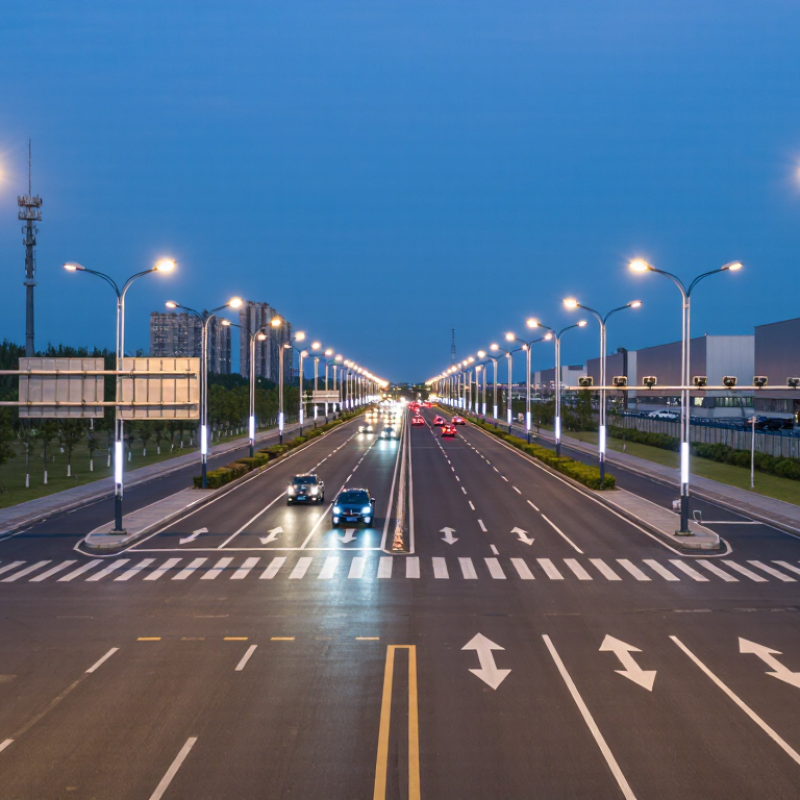
The best LED street lights in China are defined by measured performance, not bright marketing claims.
A reliable fixture should deliver stable illumination across the road surface. Uniformity matters as much as peak brightness. Dark patches create safety concerns for drivers, cyclists, and pedestrians.
Field inspections should examine the light at different times and weather conditions. A 4000K color temperature often provides clear visibility without excessive glare. Precise optics should direct light toward lanes and sidewalks, not nearby apartment windows. Look for suitable IP protection against rain and dust, plus strong impact resistance. Surge protection is essential in areas with unstable weather. Small details matter.
A professional buyer should request photometric files, laboratory test reports, and operating temperature data.
Thermal design affects performance after years of summer exposure.
A long warranty is useful, but its conditions deserve careful reading. The supplier should explain lumen maintenance, driver replacement, and spare-part availability. Compliance with relevant Chinese and international safety requirements also supports trust. Still, no specification is perfect. I have seen efficient fixtures perform poorly when installation height or pole spacing was ignored. Site calculations must guide the final choice. Measure it carefully.
Key Performance Standards for Evaluating LED Street Lights
What Are the Best LED Street Lights in China?
Key Performance Standards for Evaluating LED Street Lights
When evaluating LED street lights in China, start with measured performance, not catalog brightness. Ask for photometric reports from accredited laboratories, such as LM-79 testing. Useful metrics include system efficacy, lumen maintenance, color rendering, and power factor. Do not judge by LED chip output alone. Driver losses and heat can reduce real performance.
Road lighting should match the required lighting class and local design conditions. Check average illuminance, uniformity, glare control, and correlated color temperature. A lower glare rating may improve comfort on wet roads. Standards such as IEC 60598, EN 13201, and applicable Chinese requirements can support a fair comparison. The exact standard matters less than verified compliance and traceable testing.
Outdoor durability needs equal attention. Look for suitable IP and IK ratings, surge protection, corrosion resistance, and stable operation across seasonal temperatures. Examine the housing, sealing gasket, cable entry, and heat sink in person. I have seen impressive samples fail after poor thermal management. That weakness is easy to miss. Request field data, maintenance records, and a realistic warranty before approving large quantities. A pilot installation can reveal uneven light, control delays, or unexpected power use. No product is perfect. Even a well-tested fixture may perform differently when mounting height, spacing, or roadside dust changes.
Leading Types and Manufacturers of LED Street Lights in China
China’s LED street-light industry is led by four practical types: grid-connected roadway lights, solar LED lights, smart dimmable fixtures, and high-mast systems. Grid-connected models suit dense urban roads because they provide stable output. Solar models work better in remote areas, but battery aging can reduce winter performance. Smart fixtures add wireless control, motion sensing, and scheduled dimming.
The strongest manufacturers usually combine optical design, thermal engineering, driver production, and outdoor testing. Many operate through OEM or ODM networks in Guangdong, Jiangsu, Zhejiang, and Fujian. Buyers should examine LM-80 and TM-21 reports, surge protection, power-factor data, and IP66 testing. A bright lamp is not automatically a good lamp.
The International Energy Agency reports that LED lighting can use up to 75% less electricity than incandescent technology. The World Bank’s ESMAP guidance also identifies 50%–70% energy savings as achievable in LED street-light conversions. Actual savings depend on dimming schedules and road classifications. CIE 115:2010 recommends selecting lighting levels according to traffic and road conditions, not simple wattage comparisons. In field audits, poor glare control remains a common weakness. Some product claims also rely on laboratory conditions. That needs more skepticism.
| LED Street Light Type | Typical Power Range | Typical Luminous Efficacy | Recommended Applications | Key Advantages | Important Selection Criteria |
|---|---|---|---|---|---|
| Traditional Cobra-Head LED Street Light | 30–250 W | 120–180 lm/W | Urban roads, highways, arterial roads and general municipal streets | Wide availability Easy retrofit Multiple optics | Road width, mounting height, pole outreach, light distribution, surge protection and maintenance access |
| Modular LED Street Light | 60–300 W | 130–190 lm/W | Highways, large intersections, ports, industrial roads and high-output projects | Scalable output Replaceable modules Thermal flexibility | Module compatibility, heat dissipation, driver replacement, optical uniformity and spare-part availability |
| All-in-One Solar LED Street Light | 20–120 W LED load | 120–180 lm/W | Rural roads, parks, pathways, remote areas and locations without reliable grid access | Off-grid operation Integrated design Low trenching cost | Solar resource, battery capacity, autonomy days, panel orientation, winter performance and charge-controller protection |
| Split-Type Solar LED Street Light | 20–150 W LED load | 120–180 lm/W | Regions requiring larger solar panels, extended autonomy or flexible panel placement | Larger battery options Flexible installation Better serviceability | Separate cable protection, battery enclosure, panel mounting angle, battery chemistry and theft resistance |
| Smart LED Street Light | 30–250 W | 120–180 lm/W | Smart-city networks, traffic corridors, campuses and streets requiring centralized management | Remote monitoring Dimming schedules Fault alerts | Communication protocol, network coverage, cybersecurity, interoperability, data ownership and control-system fees |
| Adaptive Dimming LED Street Light | 40–250 W | 120–185 lm/W | Residential streets, traffic-sensitive roads and areas with predictable low-traffic periods | Energy savings Reduced glare Flexible scheduling | Dimming curve, minimum safety level, motion or traffic sensors, driver compatibility and fail-safe operation |
| Decorative LED Street and Urban Lighting | 20–150 W | 100–170 lm/W | Historic districts, boulevards, residential developments, plazas and public spaces | Architectural appearance Good visual comfort Custom housing | Glare control, color consistency, structural wind load, corrosion resistance and compliance with local design rules |
| High-Mast LED Lighting | 300–1,200 W per luminaire | 120–175 lm/W | Interchanges, container yards, airports, stadium surroundings and large open areas | Large-area coverage High mounting heights Fewer poles required | Photometric design, glare limitation, wind loading, maintenance method, lifting equipment and structural safety |
| Tunnel and Underpass LED Lighting | 50–400 W per luminaire | 110–170 lm/W | Tunnels, underpasses and covered road sections | High reliability Fast switching Controlled luminance | Daylight-linked control, emergency operation, tunnel environment, impact resistance, fire requirements and ingress protection |
| Recommended Technical Baseline for Procurement | Project-specific | Preferably 130 lm/W or higher at system level | Most public-road and municipal lighting projects | Balanced performance Lower lifecycle cost Easier tender comparison | Require photometric files, LM-79 or equivalent performance data, LM-80/TM-21 LED lifetime evidence, IP66 or higher housing protection, appropriate impact resistance, surge protection, dimmable drivers and a project-specific lighting calculation |
How to Choose LED Street Lights for Different Road Applications
What Are the Best LED Street Lights in China?
Choosing LED street lights depends on the road, not only the fixture’s wattage. A highway needs long spacing, strong uniformity, and carefully controlled glare. Narrow road optics can reduce wasted light on nearby land. For city streets, asymmetric lenses usually direct light toward lanes and sidewalks. This improves visibility without creating harsh brightness for residents.
Residential roads need lower output and warmer color temperatures, often between 2700K and 4000K. These settings can feel more comfortable at night. Pedestrian paths and cycleways require even lighting, low glare, and reliable dimming. Industrial roads may need higher impact protection, especially near loading areas. Check the fixture’s IP and IK ratings before installation. Coastal projects also need corrosion-resistant housings and protected connectors.
Photometric files should be tested against the actual pole height, spacing, road width, and surface color. A high-lumen lamp is not automatically better. In field evaluations, poor optical distribution often creates bright patches and dark gaps. I have also seen projects overlook cleaning access and surge protection. That mistake becomes expensive after several seasons. Select LEDs with stable thermal management, replaceable components, and documented lifetime testing. Controls can reduce output during quiet hours, but dimming must preserve safe visibility. Local climate, maintenance skills, and power quality deserve equal attention.
Installation, Maintenance, and Cost Considerations for LED Street Lights
Choosing LED street lights in China requires more than comparing wattage. Installation should begin with a photometric plan for road width, pole spacing, traffic, and nearby buildings. A qualified engineer should verify illumination levels and local electrical requirements. Fixtures should have suitable weather protection, strong surge protection, and corrosion-resistant housings. Small details matter. Cable glands must be sealed, terminals tightened, and mounting bolts checked with the correct torque. Poor alignment can create dark patches, even when the lights are powerful.
Maintenance is easier when every fixture has a clear identification number. Inspect poles, cables, seals, and lenses at least twice a year, especially after typhoons, heavy rain, or construction work. Dust on the lens reduces useful light and increases energy waste. Clean it carefully; rough materials may scratch the surface. Drivers and surge protectors can fail before the LED module, so spare parts should be stored locally. This is often overlooked.
Cost estimates should include fixtures, lifting equipment, wiring, labor, permits, inspections, and future repairs. Our early budgets sometimes underestimated traffic control and installation time. That mistake was expensive. A lower purchase price may create higher maintenance costs later. Compare total ownership cost over eight to twelve years, not only the invoice. Dimming schedules and smart controls can reduce consumption, but complex systems need trained technicians. Keep it practical. A reliable design is usually better than an impressive specification sheet.
Related Posts
-
How to Choose the Right LED Street Lights for Your Urban Environment
-
Innovative Trends in LED Street Lights Unveiled at 2025 China Import and Export Fair
-
What Are the Top LED Street Lights for Global Buyers?
-
Why Choose LED Street Lights for Global Projects?
-
Top Street Light Suppliers for Global Buyers
-
How to Choose the Best Solar Powered Outdoor Lights for Your Home and Garden