What Are the Top Types of Solar Powered Outdoor Lights?
Solar powered outdoor lights have moved beyond simple garden markers. They now include pathway lights, wall-mounted security fixtures, motion-sensing floodlights, string lights, and portable lanterns. Each type serves a different setting. A narrow path needs even, low-level illumination; a driveway may need a brighter beam triggered by movement. The right choice depends on placement, winter sunlight, battery capacity, and how long the light must stay on after dusk.
The wider energy trend helps explain their growing visibility. The International Energy Agency’s Renewables 2023 report projected that global renewable power capacity would expand by about 2,400 gigawatts between 2022 and 2027, with solar leading growth. IEA Executive Director Fatih Birol described the shift this way: “Solar is the new king of electricity markets around the world.” That quote concerns electricity broadly, not outdoor fixtures specifically, but it captures the momentum behind solar technology. Still, a bright product label does not guarantee dependable lighting. Shade, cloudy weather, and small panels can reduce performance—details that are easy to overlook. This guide compares the leading types of solar powered outdoor lights by purpose, typical placement, and practical trade-offs, so you can match the fixture to the space rather than choose by appearance alone. Expect useful differences, not a perfect one-size-fits-all answer.
How Solar-Powered Outdoor Lights Work
A solar-powered outdoor light collects energy during the day and stores it for nighttime use. Its solar panel turns sunlight into electrical energy, which a charge controller directs to a rechargeable battery. After dark, a light sensor signals the circuit to power the LED. Some models also use motion sensors, so the light stays dim or off until someone approaches. Simple, but not magic.
Tips: Place the panel where it gets several hours of direct sun, not beneath a porch roof or thick tree canopy. Wipe away dust and pollen with a soft, damp cloth. Check that the panel angle faces open sky, and keep nearby shrubs from casting new shadows. Small obstructions matter.
Runtime depends on sunlight, battery capacity, temperature, and brightness settings. A cloudy afternoon may mean a shorter evening, especially in winter. Motion-activated settings can help conserve stored energy, though they may not suit every walkway. If a light fades early, inspect the panel and battery before assuming the unit is faulty. Placement is easy to underestimate; even a few feet can change its daily charge.
How Solar-Powered Outdoor Lights Work
Daylight charges a rechargeable battery through a photovoltaic panel. After dark, a light sensor switches on the LEDs, which draw power from the stored energy.
Illustrative solar input: The curve shows a modeled, normalized clear-day pattern—not measured data or a forecast. Actual charging depends on location, season, weather, panel angle, and shade.
Common Types of Solar-Powered Outdoor Lights
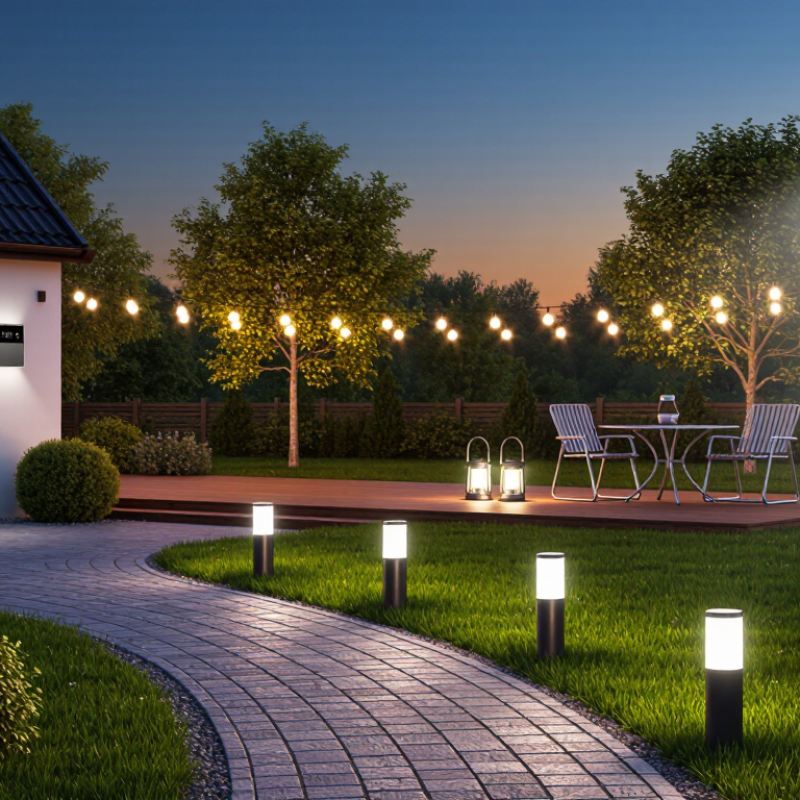
Path lights mark walkways; spotlights highlight specific features; floodlights illuminate wider areas; wall lights provide entry lighting; string lights add decorative accents; and motion-sensor security lights turn on when movement is detected.
Pathway and Garden Lights for Ground-Level Illumination
Pathway and garden lights work best when they guide feet, not compete with the night sky. Place low fixtures beside stepping stones, garden beds, and turns in a walkway. Aim light down. A warm, modest glow can reveal uneven paving without washing out nearby windows or hiding the stars. Leave space between fixtures; a continuous row can feel more like a runway than a garden.
Solar performance depends on daylight, shade, and season. A light beneath a dense shrub may charge poorly, even on a bright day. Keep panels clear of leaves and check them after storms. The U.S. Department of Energy’s Energy Saver guidance says LEDs use up to 90% less energy and last up to 25 times longer than incandescent bulbs. That efficiency suits small solar panels, but it cannot overcome weak charging conditions. Check the maker’s stated runtime, then test one fixture in its intended spot for several cloudy days. A little trial and error helps. I’ve found that spacing often matters more than adding extra lights; still, personal preference and path layout can change the result.
Solar Spotlights and Floodlights for Focused or Wide-Area Lighting
Solar spotlights and floodlights solve different outdoor lighting problems. A spotlight sends a narrow beam toward one feature, such as a stone wall, tree trunk, house number, or garden sculpture. This concentrated light creates contrast and can help visitors notice a path landmark. Floodlights spread light over a broader area, making them more suitable for a driveway, patio, or shed entrance. They can reduce dark patches, though a single unit may still leave corners dim.
For useful results, check the beam angle, brightness, and panel placement before choosing. A spotlight with an adjustable head can be aimed away from bedroom windows and toward the feature you want to highlight. For a floodlight, compare its intended coverage with your actual space; coverage can vary with mounting height and surroundings. Keep the solar panel clear of shade, especially during hours of direct sun. Small branches matter. Cloudy weather and winter days can shorten runtime, so solar lights may not perform identically every night.
Tips: Test the light after dark before fixing its position permanently. Aim it at the ground or a wall, not directly into someone’s eyes. Wipe dust from the panel regularly, and watch for seasonal shade changes. If the result feels harsh, lower the angle or use fewer lights; brighter is not always better.
What Are the Top Types of Solar Powered Outdoor Lights? – Solar Spotlights and Floodlights for Focused or Wide-Area Lighting
Compare common spotlight and floodlight styles by beam coverage, typical brightness, operation, and best use.
| Light Type | Typical Beam and Brightness | Best For | Common Features | Placement and Installation |
|---|---|---|---|---|
| Adjustable Single-Head Spotlight | Narrow, focused beam; commonly about 100–500 lumens. | Highlighting trees, signs, garden features, or architectural details. | Tilting or swivelling head; some models offer multiple brightness settings. | Stake into soil or mount on a wall. Aim the panel toward direct sunlight and the light toward the feature. |
| Multi-Head Solar Spotlight | Several focused beams; total output commonly about 200–800 lumens, depending on the model. | Lighting multiple plants, a pathway edge, or a wider façade with separate beams. | Individually adjustable heads; often includes a separate solar panel connected by a cable. | Position the heads to cover separate targets. A remote panel can be placed in a sunnier spot than the lights. |
| Compact Solar Floodlight | Broad beam, often around 90–120 degrees; commonly about 300–1,000 lumens. | Small patios, entryways, sheds, and short sections of walkway. | Wide lens; may provide dusk-to-dawn or manual operating modes. | Wall-mount above the area to be lit, with the panel facing an unobstructed, sunny location. |
| Motion-Sensor Solar Floodlight | Wide-area beam; commonly about 500–2,000 lumens while illuminated. | Driveways, entrances, side yards, and other areas where light is needed when movement is detected. | Passive infrared motion sensor; adjustable detection range, duration, or sensitivity on many models. | Mount where the sensor has a clear view of approaching movement. Motion-triggered use can help conserve stored energy. |
| Multi-Panel or Multi-Head Floodlight | Broad, adjustable coverage; commonly about 800–2,500 lumens across the fixture. | Larger patios, garages, gardens, and open areas that need coverage in more than one direction. | Two or more movable light heads; some models combine motion sensing with selectable modes. | Mount securely and angle each head toward a different part of the area. Check that nearby structures do not shade the panel. |
| Remote-Panel Floodlight | Broad beam; brightness varies by model, commonly about 500–2,000 lumens. | Shaded entrances, covered structures, and locations where the light and panel need different positions. | Separate solar panel linked to the fixture by a cable; may include a motion sensor or dusk-to-dawn mode. | Mount the light where coverage is needed and place the panel in a sunnier position. Secure the cable and avoid sharp bends. |
Wall-Mounted Solar Lights for Entrances and Security
Wall-mounted solar lights work well beside entrances because they illuminate door handles, steps, and approaching faces without trenching cables. Choose a model with a motion sensor and a shielded beam, aimed toward the path rather than a neighbor’s windows. A steady low glow with brighter motion activation can conserve stored energy. Look for clear lumen and battery-runtime specifications; vague “all-night” claims are hard to verify.
The U.S. Department of Energy’s Energy Saver guidance reports that LEDs use at least 75% less energy and can last up to 25 times longer than incandescent bulbs. Efficient LEDs help a compact solar panel support useful illumination. Placement still matters. NREL’s PVWatts tool estimates solar production using location, weather, tilt, and system losses, reflecting why winter shade can reduce charging. Keep the panel clear of eaves and tree shadows, and angle it toward the strongest available daylight. Check the light after a cloudy stretch. It may dim sooner than expected, and that is worth considering before relying on it for a dark entrance.
Decorative Solar Lights: String Lights, Lanterns, and Accents
Decorative solar lights add a softer layer than bright security fixtures. String lights can trace a fence or patio roof; lanterns suit steps and table corners, while small accents highlight planters. Look for warm-white LEDs, weather-resistant housings, and replaceable batteries where possible. The U.S. Department of Energy reports that LED bulbs use at least 75% less energy and last up to 25 times longer than incandescent bulbs. That comparison supports choosing efficient LEDs, though it does not guarantee a solar string’s runtime.
Small panels need good daylight. A shaded pergola may leave lights dim before midnight, even when the package promises long operation. In my experience, spacing matters too: one lantern beside a doorway often feels more useful than six scattered across a dark lawn. Solar decorations are atmospheric, not dependable task lighting. Cloudy weeks can disappoint.
Tips: Put the panel where it receives several hours of direct sun, and wipe dust from its surface occasionally. Test the layout for a few evenings before fixing clips or stakes permanently. Choose a timer or dimming mode if available; lower brightness can help stored energy last longer. Check the battery compartment after wet weather, since water ingress can quietly shorten a light’s life.
Related Posts
-
Exquisite Chinese Craftsmanship in Best Solar Lights for Global Buyers
-
China Top 10 Solar Lights Manufacturers for Global Buyers?
-
Maximizing Cost Efficiency with Street Light Maintenance Strategies Five Essential Tips for Global Buyers
-
Navigating the Challenges: Common Issues with LED Street Lights Explained
-
Top 10 Types of Solar Street Lights for Global Buyers
-
Top 10 Solar Lights in 2025 for Efficient Outdoor Illumination